
Stein Seal’s Contribution to the Aspirating and Hydrostatic Face Seals
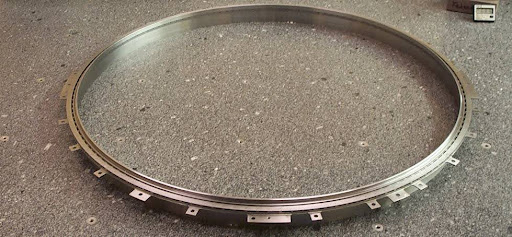 The conventional standard for seals used in gas turbines has traditionally been a labyrinth or brush seals. However, like most mechanical seals, both of these configurations suffer from performance degradation over time due to wear. In the early 1990s, Stein Seal began work on an alternative seal mechanism using a thin layer of gas or vapor to generate lift between seal faces for a non-contact seal.
Stein Seal patented specially designed grooves on the seal face to draw the barrier gas in as the shaft begins to rotate. The aspirating seal depends on that rotation to maintain lift and the seal integrity.
The Benefits of the Aspirating Seal
There are many benefits to the aspirating seal, when compared to its predecessors, namely, the brush seal and the labyrinth seal. Foremost is wear. Riding on a thin film of air, the aspirating seal is actually a dry-running zero-contact design, meaning there is no need for lubrication and no wear of the seal face due to friction. This already puts the aspirating seal at a distinct advantage over its more conventional rivals which rely on lubricants to minimize friction-induced surface wear.
Here are the main advantages of the aspirating seal:
- Provides controlled leakage throughout all operating conditions.
- Performance does not degrade over time.
- Operates at high speed, temperature, & pressure.
Aspirating seals are suitable for high-speed applications and clean, dry gas environments and are often used in:
- Gas compressors
- High-speed turbines
- Oil and gas processing
The problem with the aspirating seal comes when it is time to shut it down. Because the seal depends on lift generated by shaft rotation, leakage is a problem when the operation shuts down. Through the early 2000s, Stein worked on solving this problem with the development of another patented carbon seal design, the carbon hydrostatic face seal.
Better Yet, the Carbon Hydrostatic Face Seal
The carbon hydrostatic face seal works in much the same way as the aspirating seal, but rather than depending on the shaft rotation to create lift for the seal face, this design incorporates an external source to create the pressurized fluid or gas layer, or barrier, between the rotating and stationary faces. It also utilizes a carbon ring as a sealing element and tiny pores for the introduction of the pressurized barrier.
Unlike the aspirating seal, the CHFS is spring-loaded to maintain contact with the rotor, even at low speeds or shutdown. This makes the CHFS ideal for high-pressure, high-load, and heavy-duty applications. Examples include aircraft engines, marine propulsion systems, power generation turbines, and high-pressure pumps.
The main benefits of the carbon hydrostatic face seal:
- Dry running – requires no oil lubrication
- Designed to operate at a small clearance
- Spring-loaded face seal in contact with rotor at DP=0
- High temperature capability
- High pressure capability
- Low air leakage
- Long seal life
- Metallic piston ring used as secondary seal
The most common applications of these seals is in:
- Gas Turbines (Aviation & Land)
- Thrust Balance
- Compressor Discharge
- LPT
- Labyrinth & Brush Seal Replacement
For more information on these or any other innovations in mechanical seal technology, come to the experts at Stein Seal International. We’ve been at the forefront of industrial seals for seventy years. Find us at steinsealind.com.


