

Dynamic Seal Testing for High-Performance Industrial Applications
When industrial seals fail in the field, the consequences can easily become high-cost and high-consequence.
What’s at stake: Unplanned equipment downtime, fluid system contamination, pressure loss across critical interfaces, potential safety incidents for workers…these are all within the realm of possibility. A lot of operations today literally can’t afford those risks if they become reality.
That’s precisely why every seal leaving our facility is not just manufactured to specification, but tested and validated under a multitude of high-performance conditions that replicate real-world service loads and edge cases. We perform full dynamic validation, including upset condition testing such as loss of gas supply, temperature excursions, and over- / under-pressure events.
The result is comprehensive data you can trust, which translates to superior seals that you can count on to perform flawlessly up to the expected service life.
At Stein Seal, dynamic seal testing services are a core engineering discipline within our process. Our test lab infrastructure reflects that priority in ways few suppliers in the industry can match.
A Test Lab Built for Real-World Operating Conditions
Our 7,000-square-foot Dynamic Test Lab operates 25+ dedicated test rigs, including two custom inter-shaft rigs engineered specifically for piston ring and counter-rotating seal configurations.
Each rig features fully automated data collection and control via National Instruments hardware and software, enabling continuous, unattended test cycles around the clock. The control system allows our engineers to monitor seal and rig performance in real time while setting parameter limits that accurately replicate target operating environments.
We conduct both industry-standard high-temperature testing and seal vibration testing across our full rig inventory. Test parameters span oil pressures up to 4,000 psi, gas pressures up to 3,000 psi, and temperatures up to 815 degrees C (1,500 degrees F). These are carefully engineered simulations grounded in the same environmental specifications our customers submit for qualification programs.
Of course, rig count and instrumentation only tell part of the story. What truly differentiates our testing capability comes down to three primary factors: rig orientation, seal diameter range, and rotational speed capability.
One of the Only U.S. Labs with Horizontal-to-Vertical Rig Configurations
A major capability that separates Stein Seal from every other seal manufacturer and independent test lab in the market: Stein is one of the only organizations that has a test rig that is configurable in both horizontal and vertical orientations, and we are the only company offering this combination of configurations in our facility.
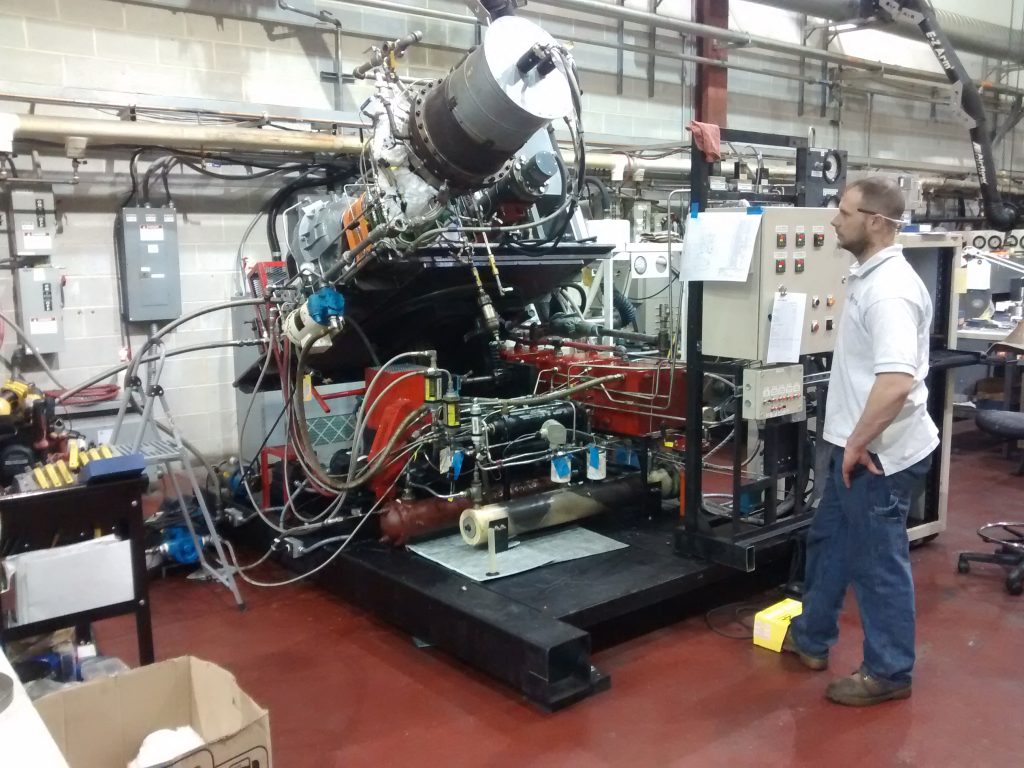
It’s a distinction that carries real engineering significance. Many rotating equipment platforms, particularly in aerospace propulsion and advanced industrial turbomachinery, do not operate in a fixed geometric plane.
Orientation shifts during operation introduce different gravitational load vectors at the sealing interface, altered fluid distribution patterns within the seal cavity, and changes in contact pressure profiles across the sealing faces. Testing only in a horizontal configuration leaves a gap in the validation dataset for any application where the equipment operates or is installed vertically.
Our horizontal-to-vertical rig flexibility allows test programs to replicate the full range of real installation and operating geometries, yielding more thorough validation data that meets real-world conditions.
Seal Diameter Testing Up to 24 Inches
Our general test capability covers seal diameters up to 60 cm (24 in), a range that exceeds the test envelope of most competitors. This directly serves customers working in large-scale turbomachinery, heavy industrial rotating equipment, marine propulsion systems, and select defense platforms where seal diameters fall well outside what standard commercial test equipment is designed to accommodate.
Testing a large-diameter seal at representative size, pressure, and temperature is crucial because geometric scaling can always introduce variables that cannot necessarily be reliably modeled from smaller component tests. Hydrodynamic film behavior, thermal gradients across the sealing interface, and dynamic deflection under pressure all behave differently at larger diameters. When validation requires testing at actual component dimensions, our lab has the capacity to deliver it without compromise.
Rotational Speed up to 70,000 RPM
Our rigs are rated to shaft speeds up to 70,000 rpm, placing us squarely in the performance envelope required for high-performance seals such as turbine engine applications and advanced high-speed spindle systems.
At these rotational speeds, seal behavior deviates substantially from low-speed performance predictions. Hydrodynamic lift at the sealing face becomes a primary variable, heat generation at the contact interface increases non-linearly, dynamic runout tolerances tighten, and fluid film stability must be evaluated under sustained high-speed conditions rather than extrapolated from lower-speed data.
Designing a seal for 70,000 rpm service without physically validating it at operating speed introduces risk that engineering margins alone cannot fully compensate for. Our test infrastructure closes that gap by running the seal at the actual speeds it was designed to handle.
Comprehensive Testing Integrated at Stein Seal
The test lab at Stein Seal is an integrated part of our and our customers’ engineering process. Whether you need to validate new seal designs, qualify repaired seals, or support an entire new development program, we can accommodate your project. We can also run extremely accurate run-to-failure and material wear analysis tests as needed.
We offer high capacity with 25+ rigs providing the throughput to run concurrent test programs without schedule conflicts, and our rig reconfiguration capability allows rapid transitions between program parameters.When you partner with Stein Seal, you have one expert supplier handling seal design, precision manufacturing, and full dynamic validation. The result is a complete, traceable validation record before the seal ever reaches your or your end customer’s system.


